What makes total solar eclipses so special?
Updated: Oct 5

What's really special are the coincidences associated with the size of the moon to that of the sun and the distance of the moon from earth relative to the distance to the sun. Coupled with this, the spectacular view created by a total eclipse is only a recent chapter in the moon's long 4.5 billion year history.
Coincidence 1
The sun's actual diameter is approximately 400 times that of the moon and it's distance from earth is 400 times further away than the moon. The extra distance perfectly cancels out the sun's massive size. This creates an optical illusion where both objects appear to be the same size when viewed from earth. The moon has an average angular diameter of 0.5 degrees and the sun has an average angular diameter of 0.533 degrees.
When the orbit of the moon periodically causes it to line up with the earth and the sun and because the two angular diameters match, the sun's light is almost perfectly blocked.
Coincidence 2
The moon is moving further away from the earth at a rate of about 3.8 cm (1.5 inches) every year. This is due to the gravitational interaction between the earth and the moon resulting in the moon gaining energy and the earth losing it each year. The fact that the moon is moving away from the earth implies that it must have been much closer at one time and it will get further from earth in the far distant future.
In its early existence, the moon was considerably closer to the earth and would have created a wide shadow across the earth at the time of any alignment, blotting out the sun completely. Hundreds of millions of years from now, as the moon moves further and further away from earth, its angular diameter will become much smaller than 0.5 degrees and a total eclipse will become impossible.
Eclipses have always occurred and will continue to happen for many years to come. However, we are privileged to live at the perfect geological time of the moon's existence in that the two angular diameters of moon and sun match so well.
We get treated periodically, depending on where you live, to four types of solar eclipse.
Total Solar Eclipse
This is caused when the moon's orbit brings it directly in front of the sun in what's known as totality, as viewed from a narrow range of points along the earth's surface. The only thing that is left exposed is the sun's corona, the turbulent outer atmosphere of the star. Consequently, solar eclipses provide a good opportunity to study the corona. Under normal conditions, corona light cannot be seen as the output from the sun itself is so much brighter. It's even possible to see huge arcs of glowing plasma during an eclipse, where matter is catapulted out of the sun as stressed magnetic fields in the star re-align themselves into less stressful alignments.
Einstein's most famous prediction from his general relativity was that light is bent when it passes through a gravitational field like that of the sun. In 1919 he was proved right as two teams of astronomers led by Arthur Eddington observed light from a star known to be behind the sun during the total eclipse that year. The star became visible as darkness descended during totality, its light having been bent around the sun, just as Einstein predicted and he became world famous in a matter of weeks in a world with no internet!
Annular Solar Eclipse
The moon's orbit is not circular, it is elliptical and the earth sits in one of the two foci of the ellipse. It is therefore, close to one side of the orbit. When the moon is farthest from the earth (its apogee) on its elliptical orbit and passes in front of the sun, its apparent size is slightly smaller than the sun's and it doesn't obscure the whole star, but most of it. This produces a brilliant ring of sunlight creating the spectacular “ring of fire”.
Once again, the effect is only observed along a narrow range of locations across the globe.
Partial Solar Eclipse
Anyone located on either side of the line representing the narrow path of totality of an eclipse, may see part of the sun obscured, not the whole. This can range from a small percentage of the sun being obscured to 96% or more as witnessed in the UK on 12th August 2026 when a partial eclipse of the sun occurred.
Hybrid Solar Eclipse
This is a rare event that, because of the curvature of the earth, allows some to see a total eclipse and others to see an annular eclipse, depending entirely on where you live.
The Path of Totality
This represents the line of locations on earth where a total eclipse will be seen. On average, this path varies from between 160 to 260 kilometres wide (100 to 160 miles) and is the trail of the shadow that is created by a total eclipse. It varies in width according to how close the moon is to the earth.
Although the path of totality is very narrow, it is very long and can range up to 10,000 miles. This results from the speed of the moon in its orbit and the speed of rotation of the earth fighting each other.
To see an excellent animation of the path of the moon's shadows across the globe during the total eclipse of 12th August 2026, NASA have an animation that you can see by clicking on the following link:
Scroll down to where you see the video (Look for the image shown below) You can see the path of totality in red and the path of the various shadows on either side of totality.
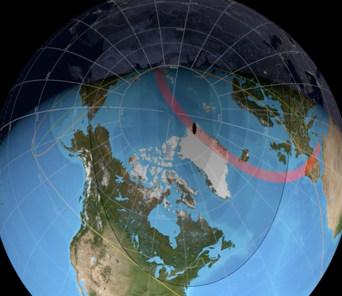
What are the shadows created by a total eclipse?
As shown in the NASA video, there are shadows created by the alignment of the earth, moon and sun that provide partial eclipses to people living in the areas affected. You can see these shadows and how they are formed in the image at the top of this article.
The Umbra
This is the darkest shadow created by a total eclipse and it follows the path of totality as the moon continues on its orbit and the earth continues its spin. Umbra is the Latin word for “shade” or “shadow”.
The Penumbra
This is the lighter part of the moon's shadow in a total eclipse. The expression means “almost-shadow” in Latin.
Key Takeaways
Although the moon completely covers the sun, its dark umbral shadow is very narrow when it reaches earth, only 160 to 260 Km wide. Outside this corridor of totality, the penumbral shadow is much larger, providing a range of partial eclipses, depending on an observer's position on earth as demonstrated in the NASA video.
We live at such a great time and are privileged to be able to see solar eclipses and partial eclipses every few years. And don't forget, it's all because the angular diameters of our star and our moon match at this point in the astronomical history of the solar system - what a coincidence!
© 2026 Kieron Conway - All rights reserved.
--
Liked this article? Check out:
where you can read all about an exciting new science series: A Journey into Modern Physics by Kieron Conway, available in three parts, from Amazon on-line shops.
Also, the web-site has an index of blog articles published to date, for easy access to an article that might interest you. You can access the index using the link above.
----


Comments